
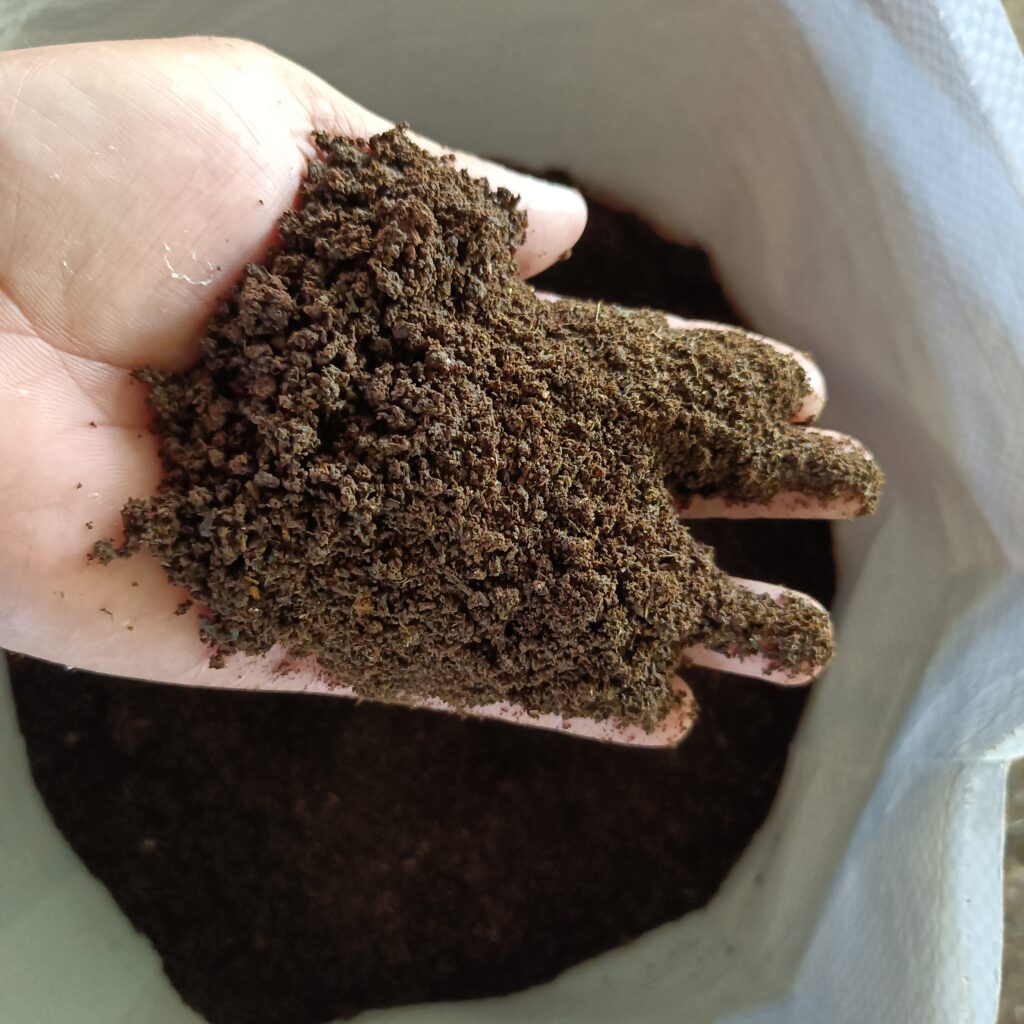
Nutrients in vermicompost
Before talking about the amount of nutrients in vermicompost. Let's understand how each nutrient is important for plant growth. And if plants lack each type of nutrient What symptoms will the plant have? And how will it affect growth? (The following information comes from Virginia Tech's publication on hydroponic plants.)
Nitrogen – The whole plant will be light green. The underside of the leaves are yellow. The plant will stop growing.
Phosphorus(Phosphorous)– The entire plant is bluish-green. Most develop red or purple. The underside of the leaves may be yellow. and will dry to a greenish-brown color and then to black. The plant will stop growing.
Potassium(Potassium)– The leaves are thin like paper. Along the edges of the leaves will dry up and die. The plant will stop growing.
Magnesium(Magnesium)– The underside of the leaves will turn yellow. The top and edge of the leaves and between the leaf veins The underside of the leaves will wilt.
Calcium - Flower stalks and young leaves will die.
Zinc(Zinc)– The leaf tissue between the leaf veins is lighter in color. then change to yellow It is thin like a sheet of paper.
Iron – The leaf pulp turns yellow while the leaf stem remains green.
Copper(Copper)– The edges of the leaves are dark green or bluish. The edges of the leaves are bent upwards. Young leaves will permanently wither.
Sulfur(Sulfur)– Young leaves turn pale green. while the old leaves are still green The plant stops growing and grows tall.
Manganese(Manganese)– The plant stops growing. The underside of the leaves has alternating yellow and green stripes.
Molybdenum(Molybdenum)– The leaves will stop growing. will turn pale green and malformed
Boron(Boron)– Young leaves will be dry and scorched at the leaf tips and leaf margins.
Molybdenum(Molybdenum)– The leaves will stop growing. will turn pale green and malformed
Boron(Boron)– Young leaves will be dry and scorched at the leaf tips and leaf margins.
Now we can guess why vermicompost is so good for growing crops. The answer is that vermicompost contains all the nutrients mentioned above. There will be more, some less, some not equal. And plants also require different amounts of these nutrients as well. Take the element molybdenum, for example. which is responsible for converting nitrate compounds into amino acids Molybdenum is a mineral (component of plant protein) which plants need more than once. But if given too much, it will be toxic to plants.
This is because the nutrients in vermicompost depend on the method of raising and feeding the earthworms. Vermicompost from different farming methods will provide different nutrients. To provide brief information Vermicompost contains nutrients and minerals in the following proportions.
– Organic carbon 20.43-30.31%
-Nitrogen 1.80-2.05%
– Phosphorus 1.32-1.93%
– Potassium 1.28-1.50%
– Carbon to nitrogen 14-15:1 %
– Calcium 3.0-4.5%
– Magnesium 0.4-0.7%
– Sodium 0.02-0.30%
– Sulfur detected up to 0.40%
– Iron 0.3-0.7%
– Zinc 0.028-0.036%
– Manganese detected up to 0.40%.
– Copper 0.0027-0.0123%
– Boron 0.0034-0.0075%
– Aluminum detected up to 0.071%.
– Cobalt and Molybdenum
From the numbers of nutrients in vermicompost above. If compared with that contained in general cultivation soil, it will be found that there is only less iron in vermicompost than in general cultivation soil. As for aluminum and magnesium They will be in similar quantities. In addition, other nutrients in vermicompost are much more abundant than in general cultivation soil, such as nitrates. In vermicompost, there are 9 times more than in general cultivation soil. The presence of quite a lot of mineral compounds in vermicompost makes it an electrical conductor. Higher than general cultivation soil Although worm castings do not burn plants like chemical fertilizers, But if you use a lot at one time, it will cause the plants to stop growing as well.
From studying the appropriate ratio of vermicompost to cultivation soil. The researchers experimented with growing crops with different ratios of vermicompost and soil. It was found that the ratio of vermicompost to soil that gave the plants the best growth was Use 25% vermicompost mixed with 75% soil, but how? Just adding 10% of vermicompost to the soil will cause plants to grow significantly better than soil without adding it. But if vermicompost is added up to 40%, it will affect the growth of plants. And it will look worse than soil without adding vermicompost.
Source of information: From the article on Chemical side of worm casting of the website www.worldofworms.com